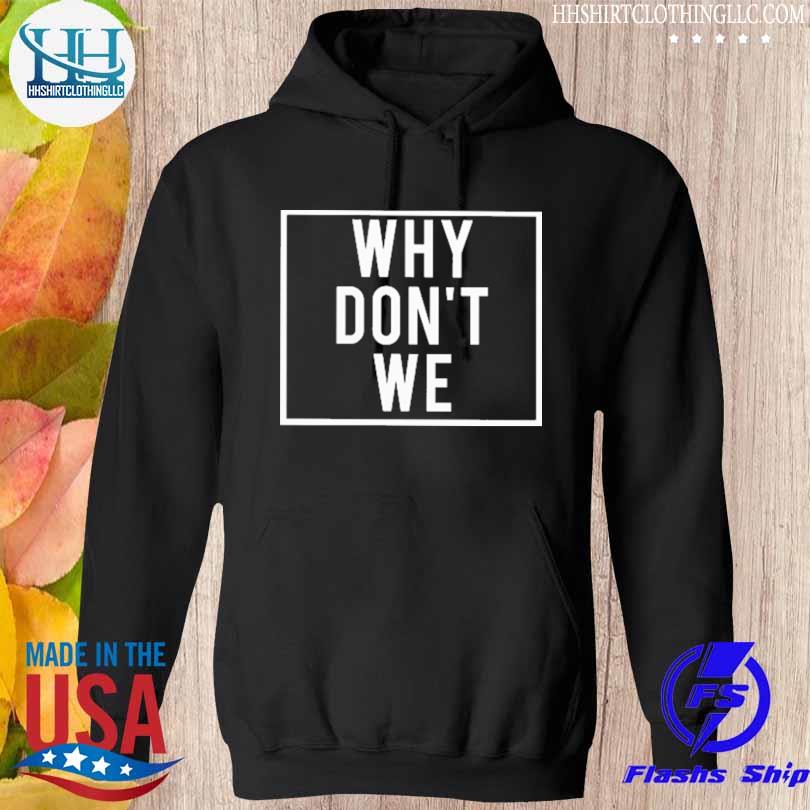
Hhshirtclothingllc - Why don’t we shirt
Buy this shirt: https://hhshirtclothingllc.com/product/why-dont-we-shirt/
The thought of having to jump through hoops to find a church that felt culturally relevant and was willing to accept us made me reflect on all the Why don’t we shirt in contrast I will get this hardships we faced just by being our authentic selves: The holidays we spent away from extended family. Our constant internal conflicts around religion. The never-ending need to educate loved ones. The friends and family who weren’t there when it mattered most. There was so much time we’d never get back—and so much disappointment still in store. I may have drowned in that loneliness had it not been for the land—89 lush, green acres of Southern land that my paternal grandfather spent his pension and the final years of his life making possible. He affectionately dubbed it Baker Acres: a plot of land covered in thin, towering pine trees and roaming white-tailed deer with two sprawling freshwater lakes fed by a winding brook. It was to be a safe haven for any of his children or grandchildren. And less than a decade later, the Baker Acres became a refuge for my wife and I when we said “I do.” I can’t remember exactly when I first had the idea of getting married on my family’s land, but it was like having a song stuck in your head. Once I entertained the thought for even a moment, it felt like what I was always meant to do.

The family land freed me in more ways than one. There was no gatekeeper there to tell me that our love was too blasphemous or that the Why don’t we shirt in contrast I will get this Lord’s house was too sacred. As Imani Perry wrote in her bestselling book South to America: “The trees don’t know your race or your gender identity or your sexuality. The trees don’t expel you for rumors or bigotries.” In fact, the hallowed ground modeled what love really was: the insistence upon blooming no matter the conditions. Over the years, this land has been home to many people; first, the Indigenous Lumbee people, followed by colonizers, and eventually, us Bakers. Through extractive agriculture, natural disasters, and over-yielding, the land never stopped being exactly who She had always been. In good times, the land offered bountiful harvests and a foundation for shelter. In bad times, the land listened and learned resilience. She welcomed Mariah and I without judgment, presenting us with a clean slate. As a queer Black couple, everything about it felt too good to turn down. With my grandmother’s blessing and my aunt’s support, we set to work planning our special day.


Nhận xét
Đăng nhận xét